
A friend who works at a global beverage company once told me about a gas station off the freeway in Atlanta. During the day it was a stop for construction workers, and at night it was a stop for college students. Her frustration was that nothing her company had could tell when that station was right for the workers and when it was right for the students.
That gap between the occasion and the channel is still open across consumer packaged goods. In a new research paper I argue that brands grow when their media and content meet people in the occasions where they buy, and that occasions can now be measured by place and by hour, across the year, without device IDs.
A category entry point has a place and an hour.
Occasions already run the store
Coca-Cola has talked about occasion-based marketing in public for more than twenty years, with in-store programs built around moments such as a summer barbecue and the dinner table. The public record shows occasions working in two places, the survey and the store. It shows no account of connecting an occasion in the physical world to the media a brand buys.
Why occasions should matter
The Ehrenberg-Bass Institute explains why buying situations decide which brand people choose. Jenni Romaniuk made the buying situation concrete with category entry points, the moments when someone mentally enters a category.
A category entry point has a place and an hour, so a large share of them are occasions. If a brand can measure where and when those occasions happen, it can place media and content where mental availability is decided, and check its physical availability against the same map.
What the evidence says
Randomized field experiments show that matching the moment raises response, but they are all mobile promotions with a direct offer. The case for brand media rests mostly on small studies funded by vendors that sell contextual advertising.
Nobody has published a test of occasion-matched media on brand sales at scale, and a brand could run that test with its own sales.
Two gas stations, two sets of occasions
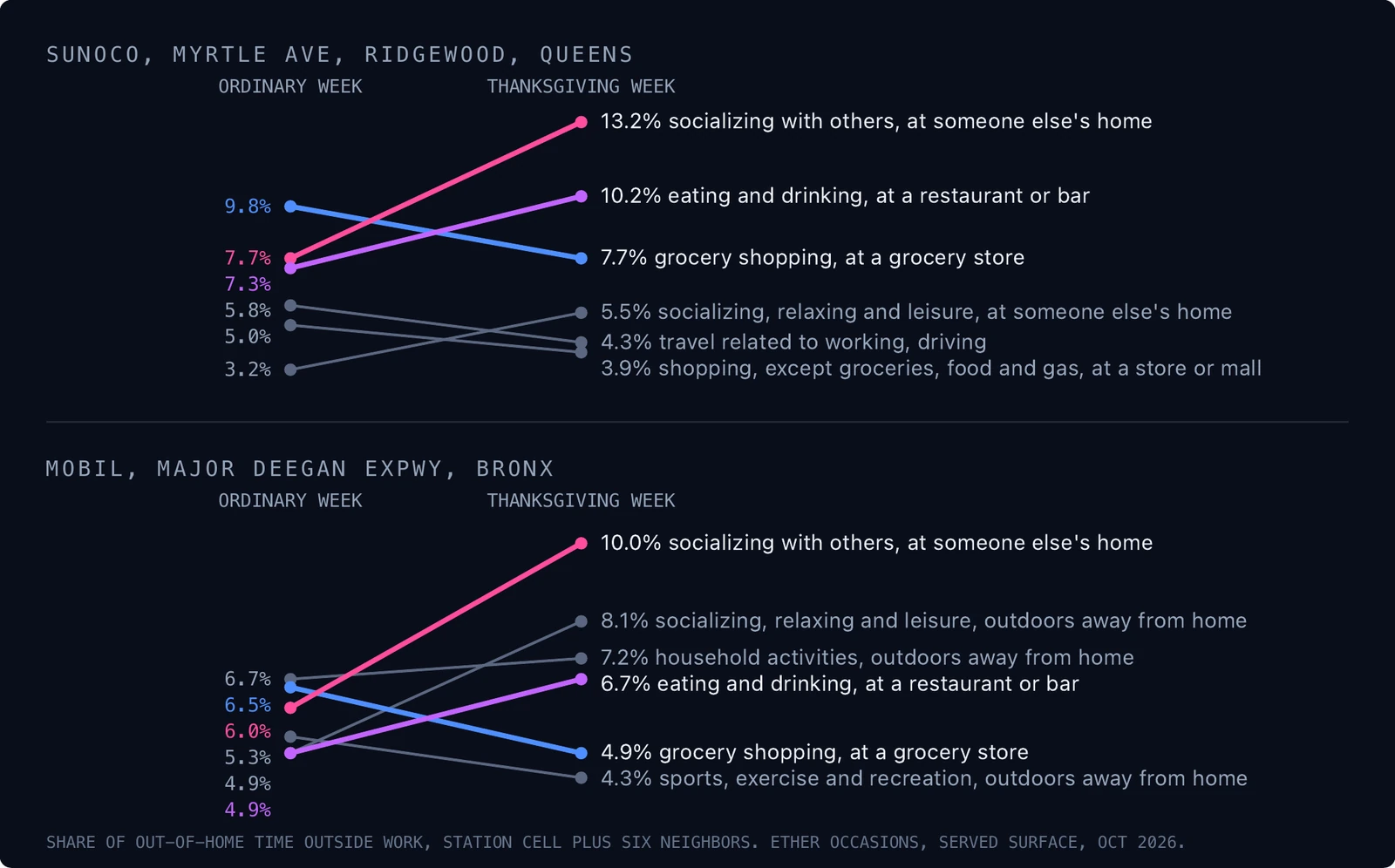
Around a Sunoco on Myrtle Ave in Ridgewood, Queens, time outside home and work goes to grocery shopping, restaurants and the drive to work. Around a Mobil on the Major Deegan Expressway in the Bronx, outdoor occasions lead. In Thanksgiving week, socializing at someone else's home rises to first place around both stations.
The practice, the theory, the evidence graded by strength, how Occasions measures each occasion by place and hour, and how a brand would plan media against occasions and read the result in its own sales.
