
A friend who works at a global beverage company once told me about a gas station off the freeway in Atlanta. During the day it was a stop for construction workers, and at night it was a stop for college students. Her frustration was that nothing her company had could tell when that station was right for the workers and when it was right for the students.
I knew that frustration from my own work. A few years ago I spent a lot of time working with the shopper marketing group of a global beverage company, and I got very close to occasions thinking, which is a big part of how a beverage company runs its in-store business through its distributors.1 An occasion, in that world, is a situation in which people drink, such as a meal at home or a summer barbecue. The occasions lived in two places, the survey research that defines them and the store, where the displays are built around the occasions each store serves. The media plan sat outside both. A planner could buy an audience, a demographic or a postcode, but could not ask where and when an occasion was happening that week, and nothing told the store team which occasions the media had reached.
That gap between the occasion and the channel is still open across consumer packaged goods (CPG), and it is the subject of this paper. My argument is that brands grow when their media and content meet people in the occasions where they buy, and that occasions can now be measured by place and by hour, across the year, without device IDs. The argument rests on public research and on our own data.
Coca-Cola plans its stores around occasions
Coke has talked about occasion-based marketing in public for more than twenty years. In 2002 a Coca-Cola director of strategic innovation described an in-store program that built displays around moments such as a summer barbecue, with the goal of catching the shopper around the occasion rather than around the product alone.2 By 2016 Coke's shopper marketing team was presenting meal bundles it sold with US grocers, food and drink at one price, built around the dinner table.3
The meal is still the center of the strategy. In 2023 Coca-Cola launched a global platform about meals enjoyed together, and supported it with its own shopper survey on Coke and food.4 In July 2025 the chief executive told investors that pairing brands with specific meals and festivals is part of how the company is responding in markets such as India, and that the portfolio exists to offer choice across occasions.5
In Coke's practice the occasion combines what people are doing with where they are doing it, as in a meal at home or a barbecue in the yard. The public record shows occasions working in two places, the survey and the store. My search of the public record found no account of Coke connecting an occasion in the physical world to the media it buys.
Buyers enter a category through situations, and brands grow by being present in them
The Ehrenberg-Bass Institute, a marketing science group at the University of South Australia, offers the theory for why occasions should matter. Byron Sharp's How Brands Grow argues from decades of purchase data that brands grow mainly by reaching more buyers, and that two things decide whether a buyer chooses a brand.6 The first is mental availability: the chance that a buyer notices or thinks of the brand in a buying situation.7 The second is physical availability: how easy the brand is to find and buy at that moment.6
Jenni Romaniuk, also at the Institute, made the buying situation concrete with category entry points (CEPs). She defines them as "the cues customers use to access memories when faced with a buying situation."8 Her checklist asks when, where, with whom, while doing what, why and with what feeling a person comes to the category.9 The Institute now describes CEPs as the moments when someone mentally enters a category.10
Brands already write about themselves this way. Batiste, the dry shampoo brand, set out years ago to grow beyond emergencies into travel, festivals and lazy days.11 In Canada, Kellogg's cereal advertising has targeted the afternoon slump and the reward after the children are in bed.12 Each of those moments is a CEP stated in time and place.
Here is the theory, and it is mine rather than the Institute's. A category entry point has a place and an hour, so a large share of CEPs are occasions in the sense used here. If a brand can measure where and when those occasions happen, it can place media and content where mental availability is decided, and it can check its physical availability (the store, the shelf, the delivery zone) against the same map. Ehrenberg-Bass has shown that buying situations matter. As far as I can find, nobody has published a way to measure them by place and hour across a whole country.
Field experiments show that matching the moment pays, and the evidence for brand media is thinner
The evidence that timing and context improve advertising results comes in three grades, and it is worth reading them separately.
Strongest: randomized field experiments, peer reviewed. In a field experiment with more than twelve thousand mobile users, a promotion targeted by time and by distance to the venue lifted purchases, and the two worked together rather than adding up simply: for people far from the venue, a message the day before beat a message on the day.13 A study of more than six million mobile users across 344 Chinese cities found that people responded more often and faster to the same promotion in sunny weather than in rain.14 In a shopping mall, offers targeted by each shopper's path through the mall beat offers targeted by location alone, on redemption and on spend.15 These studies are strong evidence that the moment changes the response. They are also all mobile promotions with a direct offer, which is a narrower case than a brand campaign.
Middle: academic and observational studies. An hourly model of television advertising found that the same ad performed differently by time of day.16 A university study of online video found that ads matched to the surrounding content improved brand recall and recognition in mid-roll positions, without changing attitudes.17
Weakest: studies funded by media owners or ad-tech vendors. A study funded by a German broadcaster found that attention and perceived fit vary by daypart, on 285 viewers.18 Three vendor studies report better memory, recall or attention for ads matched to their context, on samples of 60 to 1,200 people.19 The vendors that paid for these studies sell contextual advertising, and the samples are small, so I treat them as consistent with the field experiments rather than as proof.
Read together, the evidence says that the right moment raises response in controlled tests, and that the brand-media case rests mostly on small studies with a commercial interest. Nobody has published a test of occasion-matched media on brand sales at scale, and a brand could run that test with its own sales.
Occasions measures what groups of people do, by place and hour, without device IDs
At Ether Data we define an occasion as what a group of people does, and where. Each occasion is a row in our library, and the rows come from the American Time Use Survey, the federal diary in which Americans record how they spend a day.20 Six rows from the library, as they are written:
- People 25-44 with children, grocery shopping, at a grocery store
- People 45-64 without children, eating and drinking, at a restaurant or bar
- People 25-44 with children, travel related to working, driving
- People 25-44 with children, television and movies (not religious), at home or in the yard
- People 25-44 without children, washing, dressing and grooming oneself, at home
- People 45-64 without children, socializing and communicating with others, at someone else's home
An occasion carries no hour. The hour is what we measure. For each occasion we estimate how many people are taking part in every grid cell (an area of about a quarter of a square mile) for every hour of the week, across 52 weeks of the year, anywhere in the United States. The estimate combines national rates from the diaries with Census counts of who lives and works in each cell, and a calendar of holidays and school terms. Nothing in it identifies a person or uses a device ID, so a brand can reach the moment without identifying anyone in it.
We check the hours against records we did not use to build them. On supermarkets held out of the build, the diaries alone put the grocery peak at midday, the stores were busiest at four in the afternoon, and Occasions put the peak at four as well.21 The grocery peak is one check on one occasion.
Two gas stations in New York serve different occasions
A gas station looks like a single category, but the people around two stations can be doing very different things. We read the area around two New York stations, the station's cell plus the six cells around it, about two square miles, and ranked the occasions that take up people's time outside home and work.22
| Rank, ordinary week | Sunoco, Myrtle Ave, Ridgewood, Queens | Mobil, Major Deegan Expwy, Bronx |
|---|---|---|
| 1 | Grocery shopping, at a grocery store (9.8%) | Household activities, outdoors away from home (6.7%) |
| 2 | Socializing with others, at someone else's home (7.7%) | Grocery shopping, at a grocery store (6.5%) |
| 3 | Eating and drinking, at a restaurant or bar (7.3%) | Socializing with others, at someone else's home (6.0%) |
| 4 | Travel related to working, driving (5.8%) | Sports, exercise and recreation, outdoors away from home (5.3%) |
| 5 | Shopping, except groceries, food and gas, at a store or mall (5.0%) | Socializing, relaxing and leisure, outdoors away from home (4.9%) |
The area around the Ridgewood station is a dense neighborhood, and its time goes to grocery shopping, restaurants and the drive to work. The area around the Bronx station holds far fewer people, and outdoor occasions lead there. A brand buying screens or mobile media near both stations would want a different message at each.
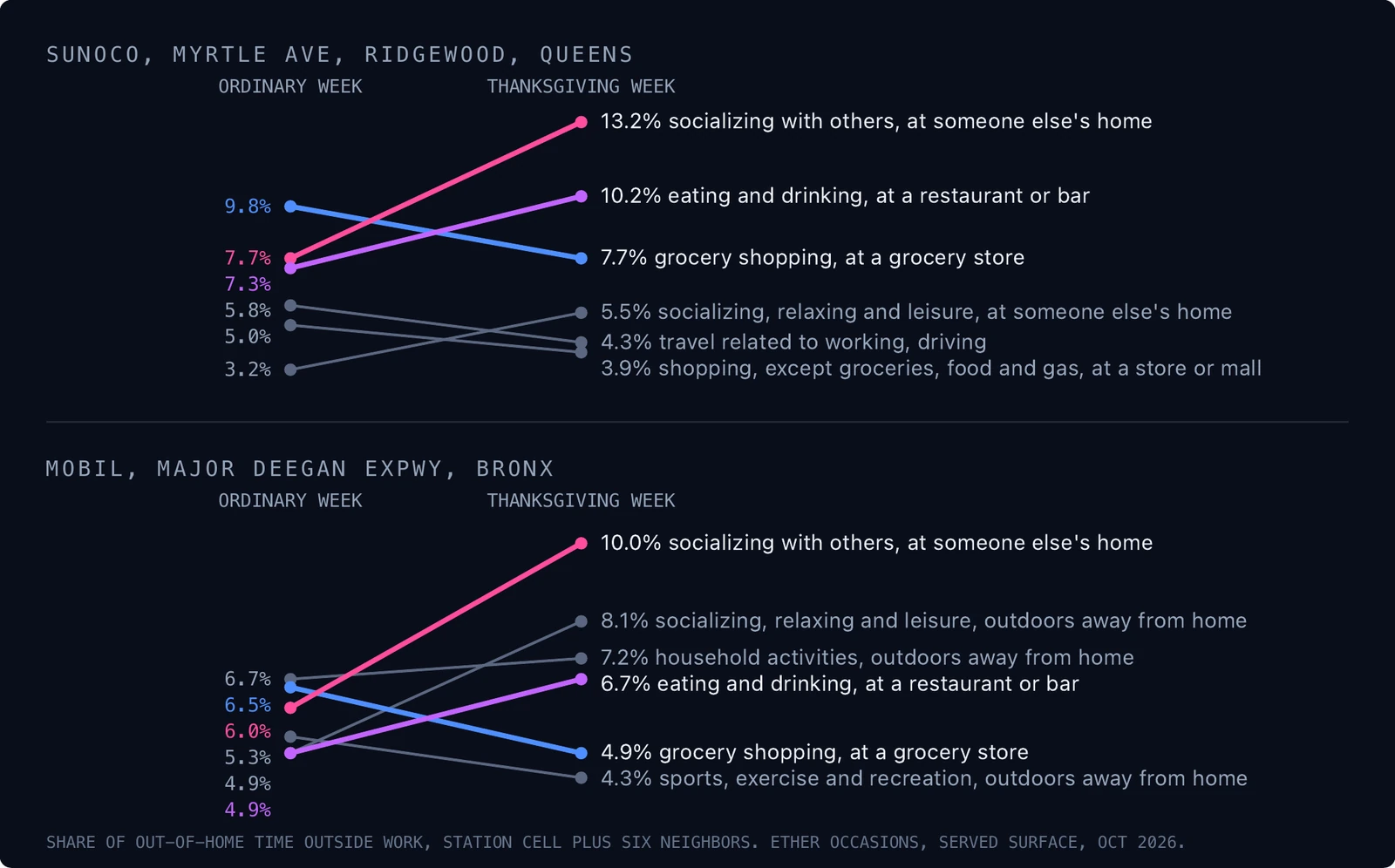
The calendar reorders both lists. In Thanksgiving week, socializing at someone else's home rises to first place around both stations, and eating out rises with it. Around the Ridgewood station grocery shopping falls from first to third. Summer weeks move the lists less, lifting outdoor occasions in the Bronx and visits to friends and family in Ridgewood. Two ordinary weeks in October give almost the same answer, because the calendar is the only thing that moves the weekly result.
The same read works for any channel with a location. On a Chicago screen in the Loop, taken from a 2022 screen file, degree classes lead the occasions nearby in an ordinary October week, and going out leads in Thanksgiving week.23
A brand can plan media against occasions and read the result in its own sales
If the theory holds, a brand would use occasions in three steps, and the first is translation. A brand team that already knows its category entry points can find the occasions in the library that match them. The match is a judgment the brand makes, and the library makes it explicit and testable.
A personal care portfolio shows why the match matters. Church & Dwight describes its own products by different moments: Batiste refreshes hair between washes, TheraBreath is for fresh breath whenever and wherever the need comes up, Touchland is sold as an on-the-go essential, and the company calls a Hero patch made to be worn under makeup a new usage occasion.24 Refreshing hair between washes belongs to the grooming occasion at home, while the other products travel with people into occasions away from home, from the drive to work to eating out. A portfolio managed by category needs presence in both kinds of moment, and each brand team can name the occasions its product is for.
The second step is the plan. For each chosen occasion, Occasions shows where and in which hours of which weeks the occasion is largest, so the plan can put screens near the places where it happens, with more weight in the holiday and summer weeks that change it, and can time in-home video to the hours when people watch television at home. The planner still chooses the channel, and Occasions shows where and when within that channel to spend.
The third step is the read. The cleanest test splits markets: run the occasion plan in some markets, hold matched markets back, and compare the brand's own sales over the following months. The brand's sales are the record. Ether supplies the plan and the method, and the result belongs to the brand. We would measure at the level of a market rather than a single store, because one store's sales are too noisy to read.
In the shopper marketing work the occasion lived in the survey and in the store, and the media plan could not see it. My friend's gas station in Atlanta raises the same question about one corner of one city: which occasion is under way there, and at what hour. Occasions gives a brand a way to answer that question by place and hour across the country, starting with the occasions we can measure well today, so a media plan can buy the channel that reaches people during the occasion and the brand can read the result in its own sales. That is the connection we were missing, the moment in the store joined to the channel that reaches it.

Sources, with the strength of each
Each note names the publisher, the date and the kind of evidence: company statement, independent, peer reviewed, or funded by a party that sells the thing studied. We checked each web source against the live page on 2026-10-08.
- 1The author's own account of his work with the shopper marketing group of a global beverage company, and of a friend's account of the Atlanta gas station. Neither the client nor the friend is named.
- 2Carol Angrisani, "Coke intensifies occasion-based marketing," Supermarket News, 2002-06-10, quoting Sean Seitzinger, Coca-Cola director of strategic innovation. Company statement, reported by trade press. supermarketnews.com/grocery-marketing/coke-intensifies-occasion-based-marketing
- 3Stephen Whiteside, "Coca-Cola's shopper marketing targets the dinner table," WARC, 2016-09-19. Independent trade press reporting a company presentation. warc.com/content/article/event-reports/coca-colas-shopper-marketing-targets-the-dinner-table/en-gb/108887
- 4The Coca-Cola Company, the "Recipe for Magic" meals platform announcement, 2023-04-03. Company statement; the shopper figures in it come from Coca-Cola's own survey. coca-colacompany.com/media-center/coca-cola-recipe-for-magic-meals
- 5The Coca-Cola Company, Q2 2025 earnings call, prepared remarks by James Quincey, 2025-07-22, corrected transcript (FactSet CallStreet) on the investor site. Company statement to investors. investors.coca-colacompany.com
- 6Byron Sharp, How Brands Grow: What Marketers Don't Know, Oxford University Press, 2010. Book by an academic institute director.
- 7Byron Sharp, "Mental availability is not awareness, brand salience is not awareness," Ehrenberg-Bass Institute, undated. Independent academic institute. marketingscience.info/news-and-insights/mental-availability-is-not-awareness-brand-salience-is-not-awareness
- 8Ehrenberg-Bass Institute, "Linking brand messages to buying situations wins the mind and the market," featuring Jenni Romaniuk, about 2022 (reposted from Marketing Week). Independent academic institute. The quotation in the text is from this page. marketingscience.info/news-and-insights/ehrenberg-bass-linking-brand-messages-to-buying-situations-wins-the-mind-and-the-market
- 9Jenni Romaniuk on Better Brand Health (Oxford University Press), Big Eye agency podcast transcript, part 2, date not confirmed. The author's own statement on a third-party site. bigeyeagency.com/insights/better-brand-health-with-jenni-romaniuk-part-2
- 10Ehrenberg-Bass Institute, "Category entry points dissected: how they really contribute to growth," about 2025 (originally Adformatie). Independent academic institute. marketingscience.info/news-and-insights/category-entry-points-dissected-how-they-really-contribute-to-growth
- 11"How Batiste is leading the dry shampoo market," Cosmetics Business, 2016-09-16. Independent trade press. cosmeticsbusiness.com/how-batiste-is-leading-the-dry-shampoo-market-121102
- 12Rebecca Harris, "Kellogg's campaign pushes cereal beyond morning meal," Canadian Grocer, 2025-07-04, quoting WK Kellogg Co. Company statement, reported by trade press. canadiangrocer.com/kelloggs-campaign-pushes-cereal-beyond-morning-meal
- 13Xueming Luo, Michelle Andrews, Zheng Fang and Chee Wei Phang, "Mobile targeting," Management Science 60(7):1738-1756, 2014. Randomized field experiment, 12,265 mobile users. Peer reviewed; funding not checked. ideas.repec.org/a/inm/ormnsc/v60y2014i7p1738-1756.html
- 14Li, Luo, Zhang and Wang, a Marketing Science study of weather and response to mobile promotions, as summarized in the INFORMS news release "Sunny, rainy or cloudy? New study shows how weather can impact consumer purchase response to mobile ads," 2017-07-20. Field experiments, more than six million users in 344 cities. Peer reviewed. informs.org/News-Room/INFORMS-Releases/News-Releases/Sunny-rainy-or-cloudy-New-study-shows-how-weather-can-impact-consumer-purchase-response-to-mobile-ads
- 15Anindya Ghose, Beibei Li and Siyuan Liu, "Mobile targeting using customer trajectory patterns," Management Science 65(11):5027-5049, 2019. Field experiment, 83,370 responses in a shopping mall. Peer reviewed. ideas.repec.org/a/inm/ormnsc/v65y2019i11p5027-5049.html
- 16Gerard Tellis, Rajesh Chandy and Pattana Thaivanich, "Decomposing the effects of direct TV advertising: which ad works, when, where, and how often?" Marketing Science Institute working paper, 1999; published in the Journal of Marketing Research, 2000. Observational, hourly model of television advertising. Academic. msi.org/working-papers/decomposing-the-effects-of-direct-tv-advertising-which-ad-works-when-where-and-how-often
- 17Shuoya Sun and others, "In-stream video advertising: effects of congruence and advertisement positions on consumer response," University of Georgia, Grady College, about 2019. Academic, conference study; not confirmed as a journal article. grady.uga.edu/research/in-stream-video-advertising-effects-of-congruence-and-advertisement-positions-on-consumer-response
- 18Jo Bowman, "Daypart affects ad attention, recall and how consumers perceive the fit of advertising," WARC, 2024-07-09, reporting a study by RTL, Screenforce and eye square on 285 viewers. Funded by media owners. warc.com/content/article/daypart-affects-ad-attention-recall-and-how-consumers-perceive-the-fit-of-advertising/en-gb/156375
- 19Vendor-funded: Integral Ad Science with Neuro-Insight, 60 US consumers, reported by ExchangeWire, 2021-09-07; GumGum with SPARK Neuro, 60 people, about 2020-03; Seedtag with Lumen, 1,200 UK respondents, attention only, 2021-12-02.
- 20US Bureau of Labor Statistics, American Time Use Survey. Federal statistics. bls.gov/tus
- 21Ether Data, the Occasions narrative and launch post, 2026-09-29. The check compares the served grocery occasion against observed busy times at supermarkets held out of the build. share.etherdata.ai/narrative
- 22Ether Data, served occasion surface, read 2026-10-08 for the weeks of 2026-10-19 and 2026-11-23 (and summer weeks for comparison). Each station's grid cell plus its six neighbors; station locations from public places data. Shares are of out-of-home time outside work. The queries and output sit beside this paper's source.
- 23Ether Data, served occasion surface, week of 2026-10-19 and Thanksgiving week, for a bus shelter screen near State and Madison in Chicago. The screen comes from a 2022 screen file, a dated third-party snapshot, not a current feed.
- 24Church & Dwight, own statements: Q4 2025 results release, 2026-01-30, on Hero Mighty Shield as a new usage occasion; Q2 2026 results release, 2026-07-31, on TheraBreath (both 8-K exhibits, sec.gov); batistehair.com and touchland.com product pages, read 2026-10-08. Company statements. Portfolio per the FY2025 Form 10-K.
About Ether Data. Ether Data measures occasions, what groups of people do and where, by place and hour across the year, for media planning and measurement. It uses no device IDs. This paper is a proposal and a theory. It reports no client results.